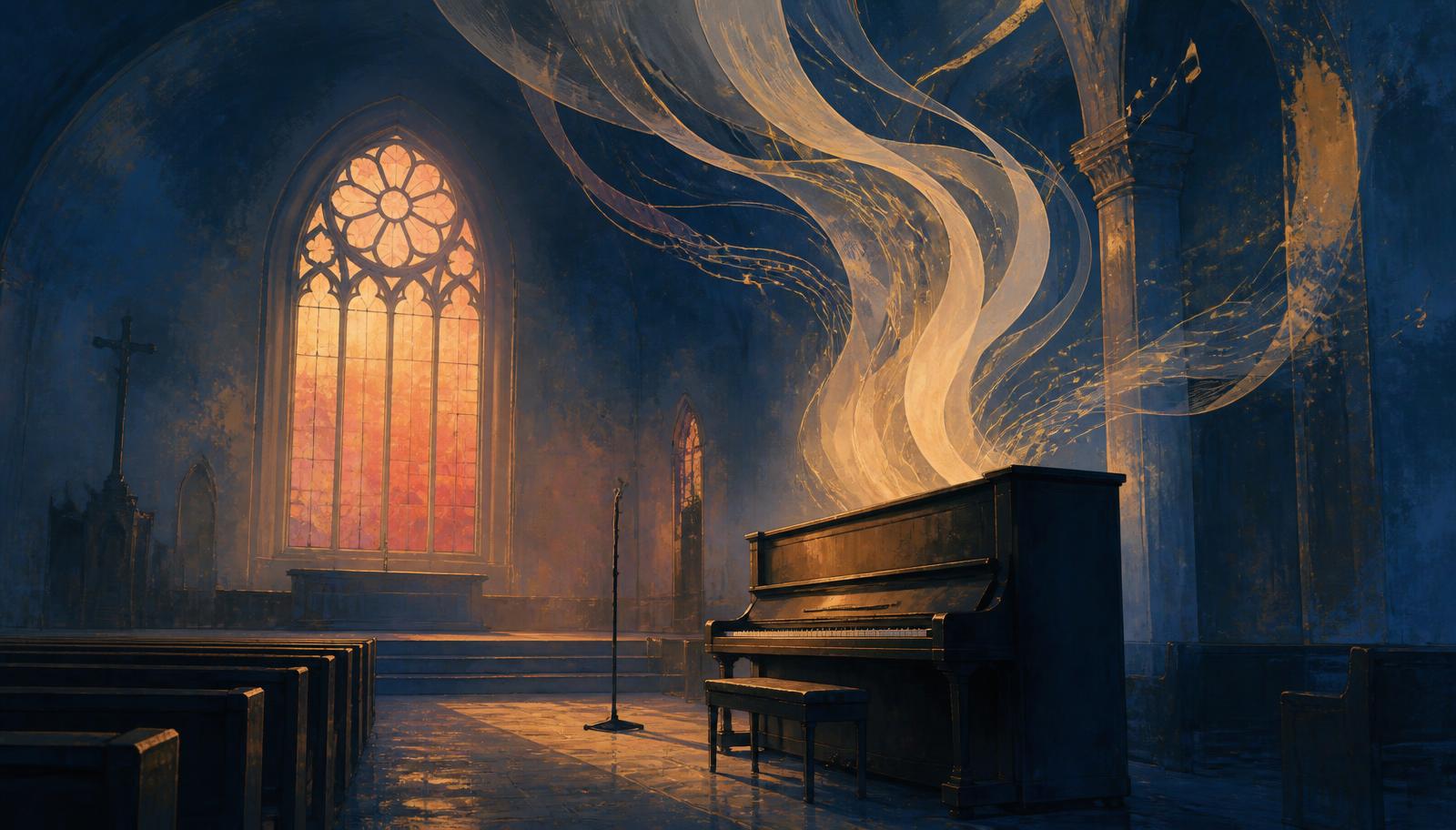
A person can type “loneliness” into an AI music generator, wait less time than it takes to microwave popcorn, and walk away with a singer, a band, a chorus, a mix, and a master. They know zero chords. They’ve never heard of a cadence. Three minutes later, they upload the track.
Music history has never had a three-minute conservatory.
So what just happened? Did they compose? Perhaps. Did the machine compose? In a functional sense, it generated music. But did choosing loneliness, describing the ache, rejecting the first five results, asking for a slower tempo, adding a key change, and finally releasing it constitute a musical act?
I believe it did. We just lack the language to describe it.
I call it AI Music Promposing. (Pronounced like composing) A composer creates a composition. An AI Music Promposer creates a promposition.
That sentence sounds playful. The change it names is not.
Before a Sentence Became a Song
I began writing music in the late 1970s, attended Shenandoah Conservatory, and graduated in 1985. We were taught that music is organized sound. Inspiration traveled through craft: harmony, orchestration, rhythm.
But I also remember the machines. Early synthesizers looked like laboratory equipment. I played a “String Machine” and heard an entire string section without bowing twenty violins. Later came drum machines, MIDI, quantization, digital sampling, and virtual instruments that placed an orchestra in a laptop. Nobody checked whether the saxophone had lungs.
Technology blurred performance and construction for decades. But the human still made the critical musical decisions. We could put random notes on staves and have the computer play what you wrote.
Generative AI crossed a different line. It produces nearly the entire musical artifact from a sentence. The distance between desire and artifact has collapsed.
Prompting vs. Promposing
When ChatGPT arrived, I became interested in one question: How much does a human have to contribute before the work becomes meaningfully theirs?
Prompting is only part of it. The person imagines, requests, listens, rejects, reshapes, and decides when it is finished. That symbiotic process is what I mean by Promposing.
Here is the framework:
• To prompose is to use language, imagination, selection, and creative judgment to bring music into being via AI.
• AI Music Promposer is the human who initiates, directs, or releases music through that process. Many would have this to include AI promposing as well.
• AI Music Promposition is the resulting work. (In essence a promposition could include video, film, an article or even an email)
To prompose is to bring an idea into existence through AI, though some may ask for AI to bring an idea to them. Authorship has a rocky road ahead.
The Spectrum of Contribution
Imagine two people:
Person A types: Sad country song. They accept the first result and upload it.
Person B writes original lyrics, maps an emotional arc, generates twenty versions, rejects nineteen, rewrites the chorus, restructures the ending, adds a live vocal, and spends two days deciding if it finally says what they meant.
Both used AI Music Promposing. Their creative contributions aren’t identical.
This is why Promposing is a spectrum, from requesting and selecting to directing and shaping. A composer and a promposer aren’t mutually exclusive. A songwriter who writes a melody, then directs an AI to arrange it, is both. Promposer names a different creative faculty: the ability to articulate, direct and maybe just select musical possibility.
What the Law Actually Says
The U.S. Copyright Office has drawn a critical line: prompts alone generally don’t provide sufficient human control for copyright protection. Human-authored expression and sufficiently creative selection, coordination, arrangement, or modification may qualify, depending on the facts.
If someone generates 100 loops, creatively selects and arranges ten, writes a vocal, and records it, the human-created vocal and potentially the selection and arrangement may be protected. That protection doesn’t necessarily extend to the underlying AI-generated elements.
If someone types “sad country song” and downloads the first result, the generated material may lack U.S. copyright protection. That doesn’t mean it automatically belongs to everyone, since contracts, platform terms, trademarks, publicity rights, and other laws may still matter.
The useful question for courts and artists isn’t simply, “Was AI involved?” It’s, “What did the human actually contribute?”
Source: U.S. Copyright Office, Copyright and Artificial Intelligence, Part 2
The Ethics of Imitation
An AI can simulate grief without losing anyone. It can reproduce gospel textures without faith. It can approximate historically Black musical language without carrying Black history, worship, exploitation, or joy in a human body.
That forces harder questions: Whose recordings trained the system? Whose voice is being imitated? Which culture has been reduced to a style instruction? Who gets paid?
The machine can’t inherit our accountability. That’s why “AI Music Promposer” should not be an automatic title of honor. It should imply responsibility. A credible promposer should be able to talk about what they wrote, rejected, selected, and brought to life. Transparency won’t answer every question, but hiding the process certainly won’t.
The Skeptic’s Objection
“This is just pressing a button. Where’s the craft?”
I understand the reflex. At the directing and shaping end of the spectrum, Promposing can resemble producing or conducting more than merely pressing a button. A film director doesn’t hold the camera or operate the crane. They articulate a vision, evaluate performances, and make thousands of judgment calls.
Top AI Music Promposers won’t be people with prompt hacks. Their advantage will come from taste, musical understanding, cultural grounding, emotional precision, and the courage to reject something technically impressive because it has nothing worth saying. The machine generates options. The human discerns meaning.
When Memory Can Become Music
My parents are ninety-two. They sang and played professionally for decades. Today, they speak memories to me: fragments of stories, old lyrics, names of places that might otherwise vanish.
Something my mother once scribbled on paper can now become the beginning of a song. A memory can acquire melody. A senior who never learned orchestration can prompose a symphony. A child with no instrument can imagine a sonic world larger than their bedroom. Someone limited by disability, geography, or exclusion can bring their internal music into audible form.
That is extraordinary.
The New Instrument
Generative AI hasn’t erased composers, singers, or producers. It has placed another creative identity beside them.
Music may still be organized sound. But in the generative era, music begins even earlier.
With intention.
With a memory.
With a single word: loneliness.
And from that word comes a song that didn’t exist three minutes ago.
The musician hasn’t disappeared. The instrument has expanded. The newest instrument may be articulated desire.
Welcome to the Age of the AI Music Promposer.
Sources
- U.S. Copyright Office. (2024). Copyright and Artificial Intelligence, Part 2: Copyrightability. https://www.copyright.gov/ai/
- U.S. Copyright Office. (2024). Artificial Intelligence Study. https://www.copyright.gov/policy/artificial-intelligence/
- Youngblood, S. (2024, January). Rubberband Ideas. Medium.
- Youngblood, S. (2023, September). AI Debates Wisdom. Medium.
- Promposer.ai. (n.d.). Retrieved August 25, 2026.
- Merriam-Webster. (n.d.). Promposal. In Merriam-Webster.com dictionary.